Here one is reminded of a somewhat modified expression of Proudhon’s: whoever invokes humanity wants to cheat. To confiscate the word humanity, to invoke and monopolize such a term probably has certain incalculable effects, such as denying the enemy the quality of being human and declaring him to be an outlaw of humanity; and a war can thereby be driven to the most extreme inhumanity.
~Carl Schmitt
The seminal lesson from this decade is that those who invoke humanity for their political goals rarely like humanity.
They rarely think humans are good, let alone free humans. Their conception of humanity is at best herd animals to be directed. More often, humanity are terrorists, disease vectors, or racists. Take COVID, where “human life” as a slogan was the excuse to tyrannize billions of innocent people for little gain. ‘Humanity’ has become a euphemism for ends that require the suppression of individual humans. Which raises a question: why is ‘humanity’ rarely claimed by the defenders of such freedoms?

The answer rests in how ‘humanity’ has been defined in practice, by law and commerce, over the past two hundred years.
The approach of the common intellectual lists averages. GDP per capita. Child morality. BMI. Life expectancy. Or our massive aggregates. Total steel produced. Electricity generated. Land settled. Crops harvested. These are not necessarily wrong metrics, but they tend to be descriptive, not instructive. If there’s a successful way to make them a moral north star, I haven’t seen it.
The moral slogan of the passing moment presents the least capable, or at least how we care for them. The elderly. Homeless. Violent criminals. The Mentally ill. “The greatness of a nation can be judged by how it treats its weakest member.” In reality, these slogans and genuine moral belief in them led to the catastrophic sacrifice of the productive members of society to those who are not only weak, but most violent and destructive.
It’s safe to say these have failed.
One alternative is the classical approach — highlight human achievement. Socrates. Caesar. Shakespeare. Michelangelo. Napoleon. In the modern day, one might elevate Jensen Huang, Taylor Swift, or Lebron James, not only to think of them as a fixed point, but to think of what human aspiration, your aspiration, could do to rival and surpass them.
I agree with this approach, and I want to highlight two successful modern works of art that share this upward-looking vision of humanity.
Frieren: Beyond Journey’s End
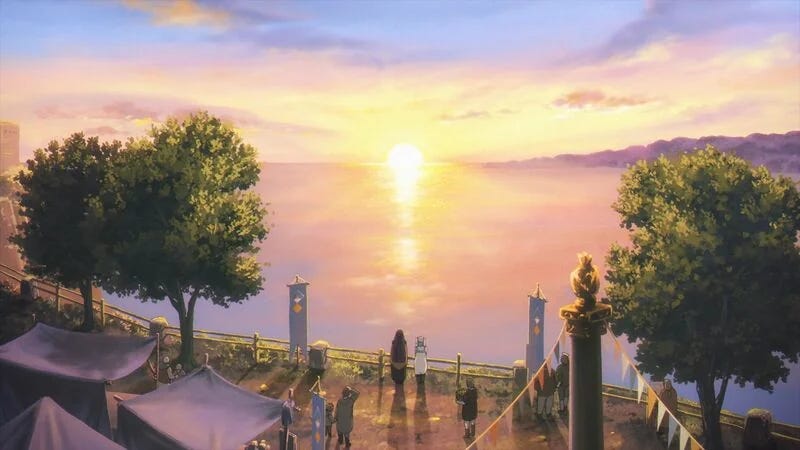
Frieren is considered the most well-regarded anime of the 2020s. It takes place in a medieval fantasy world where mankind is only beginning to develop technologies and take our place among the civilized races. In this world, mankind is advancing, creating, and fighting for good. This is the root of Frieren’s humanism: mankind ascends for the same reasons we do in real life. Frieren intentionally depicts humanity dropped into a world of magic with all the sins and virtues we possess in real life.
There are countless subtle and grand ways Frieren’s story reveals this to the audience, but one of its first plotlines stands out above the rest.
Legend tells of a great demon, Qual the Sage, sealed away by the past party of heroes. Qual, a magical scientist, invented a spell so powerful it could penetrate any defense. The party of heroes, despite being the strongest heroes in the world, could not kill Qual, but managed to seal him temporarily.

In the present day, the seal is about to break. Frieren and her apprentice go to finally kill Qual. Her apprentice is shocked Frieren does not bring any other allies. In fact, she doesn’t prepare at all. Finally, they break Qual’s seal. Qual attacks, but Frieren’s apprentice blocks them with no difficulty and Frieren immediately kills Qual.
Her apprentice asks Frieren what happened. After all, a human apprentice, nowhere close to the most powerful mages in the world, blocked Qual with ease. In the decades since Qual was sealed, human mages reverse engineered Qual’s spell. Now, even beginners are taught to defeat it. Among humans, Qual’s once-legendary spell is known as “ordinary offensive magic”.
Qual was defeated by civilization. Frieren, an elf who lives for thousands of years, is astounded that human research can match and surpass the greatest magical scientists produced by demons, elves, and any other magical race. In this world, mankind lacks the innate magical talent other races have. We lack the strength, speed, and longevity of the other races. Despite all of this, our capability for civilization, the same capability we have in the real world, has brought about “the era of humanity”.
Song of Saya
Song of Saya is a clinically insane work of art, gifted with so much divine revelation it remains one of the most wise and instructive paintings of human nature(s) in existence despite being poorly aged technologically.
The Camp of the Saints and Universal Paperclips are the dual legacies of Lovecraft. They take fear of the conceptual unknown in opposite directions. Lovecraft himself explores both; The Shadow Over Innsmouth and In the Mountains of Madness portray the feral unknown and the civilizationally advanced unknown respectively. There is a logic of cause and effect we assume in our lives. We assume it when we work or do business, when we say hello to a neighbor or care for our family. In the same way, that model of cause and effect is built up for our concepts of religion, personality, society, and purpose. Our conceptual knowledge of different relations between systems — physical systems, moral significance, human meaning — are threatened by both the feral sea-monsters and the advanced alien civilization. But how, if at all, can that fear translate to real life?
I feel a Lovecraftian tinge whenever I read Raspail’s most famous paragraph:
“They know nothing about what you are, about what you represent. Your world means nothing to them. They won’t try to understand. They’ll be tired. They’ll be cold. They’ll build a fire with your lovely oak door. They’ll shit all over your terrace and wipe their hands on the books in your library. They’ll spit out your wine. They’ll eat with their hands from the pretty pewterware I see on your wall. Sitting on their haunches, they’ll watch as your armchairs go up in flames. They’ll use your embroidered sheets to play dress up. Every object will lose the meaning you attach to it. What’s beautiful won’t be beautiful anymore. What’s useful will become laughable. And what’s useless will become absurd. Nothing will have any real value anymore, except maybe that bit of string left in a corner that they’ll fight over, breaking everything around them.”
If you have not read The Camp of the Saints, it would not be wrong to assume this concludes with some Lovecraftian alien encounter. Maybe that is what it is. But this isn’t a review of The Camp of the Saints.
Song of Saya is a 2003 Japanese porn game Visual Novel in which the meteor from H.P. Lovecraft’s Color out of Space is a sentient angelic anime girl who really really loves you. Saya is an interdimensional superintelligent alien who can biologically engineer reality at will. She loves you, the player character, because she needs an act of true love to reproduce and terraform Earth into a planet for her species. Meanwhile, some humans who have caught on investigate Saya’s origins and try to stop her and the player character.
The ending twist is one of the most beautiful in all of fiction. One might think Saya loves the player character because of the ‘contrivances of the genre’. That may be true. But in universe, Saya loves the player character because, when making first contact with humanity, Saya is so enamored by the Great human works of art — Shakespeare, the Odyssey, Crime and Punishment, so on — that she adopts the morality of human civilization. She loves the player character because she believes in true love.

The story ends in one of several ways. The player character can choose to turn himself in and is sent to an insane asylum, giving up his connection with Saya. The deutoragonist can succeed in killing the player character and Saya, with Saya giving up her life to try to save the player character in the process. Or the player character can give up his life to save Saya, both protecting her and giving her the act of true love she needs to reproduce.
A consistent theme in Lovecraft is the horror of knowledge. Knowledge itself is a curse, all the more if its knowledge of the foreign or divine. In Saya, it is human knowledge that is a deeply transformative thing, either a blessing or a curse.
In the end where Saya loses, it is her sympathy with the notion of human love that sets her on a fair playing field. In the ending where Saya wins, her faith in human love is redeemed. In all cases, Saya’s fate is intertwined with human justice.
Song of Saya is the inverse of The Camp of the Saints. It is about an alien intelligence inheriting our civilizational values, rather than biological humans discarding our civilizational values.
Admiration
The unexamined life is not worth living.
~Socrates
Recently, the art I enjoy most is about the appreciation of meaning, the elevation of understanding beyond what is obvious and immediate. There is real truth to the wisdom of philosophers and monks. Some of the most valuable ideas take lengthy examination to understand, feel, and taste. This implies that many people do not understand humanity, even if they are human. I’m willing to bite that bullet. So are countless great philosophers before me.
Egalitarian projection — imagining that a homeless man is someone with your mind who got unlucky, or that Elon is someone with your mind who got lucky — is not only a great injustice to the people the egalitarian claims to represent, but also a betrayal of oneself. Because man can change for the better. Not easily, and not in all cases. But reflection, change, and admiration is feasible, healthy, and necessary to be the best. Necessary for humanity.
Denying the appreciation of natural inequality, and the hard fought victories of striving to pursue higher virtue that comes with it, is a crime against oneself. The rejection or demonization of the concept of “elites” as such is itself a form of this egalitarian projecton.
For me, appreciation of life didn’t come naturally. I learned it after many miserable years, for which I had only myself to blame. I would like to think that those who optimize for mere human life while prohibiting all that makes it valuable are capable of this learning.