

This past year, I lived 3 months in America, 3 months in China, and 6 months in the Singapore area. Here is what I’ve been thinking about this year.
First: I joined Network School! Network School is the startup society based on Balaji Srinivasan’s The Network State (my review). Balaji is back and building the actual thing, and now I work for him. Anyone with an internet connection can apply to live in our first site near Singapore, where roughly 350 people are living right now. I’m working on software and growth, so if you want to visit, work for us, or start a company here, there’s never been a better time to reach out.
Network School is a pleasant place by East Asian standards, which means by Western standards it’s the cleanest, safest place you have ever set foot on.1 A common theme of my Asia travelogues2 is that Asian cities are so remarkably pleasant that they constitute a new level of civilization. The streets are cleaner, travel is faster, plants are greener, buildings are prettier, and of course, there’s no crime.

Equally important to me, it’s a place where you can find like-minded people to talk about software and philosophy. It gets those two things right, which makes it a place I am tying my career and future to, despite all of the advantages incumbent cities have. If you also want to inexorably tie your future here (or just visit for a month), DM me here or via email (firstname @ ns.com).
Changing my Mind
This might offend many of my friends in DC, but the most important thing I changed my mind on this year, the one thing that reality managed to beat into me despite all my biases, is that the “New Cold War” narrative is a dead end. The natural endpoint of the “New Cold War” narrative between US and China is to lock both countries into a double-suicide supported primarily by the elderly to cover for identical systems of looting from the young.
The China scam and America scam are the same. Inflate housing and pensions. Pull the rug when their ponzi scheme collapses. Make the young poorer and the old richer. Then blame the young for their economic hardship. The “New Cold War” narrative shifts blame from the failures of the boomer rulers onto the enemy across the pacific. But do you know what the most radicalizing thing is?
The most radicalizing thing isn’t to fall for a scam — it’s to watch someone else fall for it.
Infinite money for boomers is as sacred in China as it is in America. Their anti-American scapegoating follows all the story beats of an explanation, despite being entirely incoherent and contradictory. Chinese boomers have their own mantras about why the government has to prop up speculative housing prices forever, why no amount of stealing is too much as long as it extends an old man’s life from 90 to 91, and why American is the Big Bad behind all the problems they caused because … America sells dollar-denominated treasury bonds.
It’s so cringeworthy to listen to that it makes you feel bad for the people repeating it. Like an incantation, it’s a story whose only necessary proof is repetition — the anatomy of a scam.3
Then I thought back to all the public figures in American life who’s made their lives out of the same gimmick. China is to blame for selling cheap goods, those cheap goods have made life in America more expensive, and if they stop selling cheap goods, it’s because they’re out to get us. The American state demands with the ashes of its credibility that we accept, repeat, and believe that China is the Great Satan for making cheap phones and electric vehicles. Meanwhile, boomers continue to plunder from the young without any remorse, on both sides of the pacific.
You can travel 8000 miles, to the enemy civilization which we’ve been told stands for everything you oppose, only to find the same boomer kleptocracy.
Life in Startup Country
Living in Network School has changed me.
I have this bad habit of not actually finishing book reviews, for example my review of Balaji Srinivasan’s The Network State, which still only has a part 1. This is a spiritual successor to that review, except instead of reviewing the remaining two thirds of the book I’m going to review the real life Network State.
Let’s shoot the elephant in the room: this is not an objective review. Instead, you should believe what I do as much as what I say. Of all the places I could work and all the places I could live, I chose Network School.
It’s more of a city than a school. The idea is that you pay a flat $1500 rate for all the city services, including food, electricity, rent, coworking space, and gym membership. This is where I’ve been living for most of the past year, in an island next to Singapore.
My favorite phrase for Network School is zeroth world. There’s a visceral difference between third world and first. There’s a similar difference between American and East Asian cities. But NS keeps the American vibe, without the crime. One friend who read a draft of this article told me he can’t process what an American vibe is like without rampant drug use and broken windows. This is the part of the essay where I try to explain that, knowing full well that I probably wouldn’t understand it myself if I spent my whole life in the West.
There’s a genre of brilliant conversation you will have in America. It can’t easily be categorized. It’s often about software or philosophy, but not just about that. There are programmers and philosophers in other countries, but they’re culturally perverse somehow. One example: it’s clear that the UK has not believed in freedom of speech for several decades at least. Every time they say the word “freedom” they’re stochastic parrots repeating American words without any real meaning. Every non-American country has that unmistakable jester quality, though few match the British in their clownsmanship.
So, why did I actually move here?
Number one is the pleasantness. It’s a massive social good to quarantine away degenerate behavior from normal people, and to fill the normal world with pleasant and aspirational things that make you want to spend your life there. But how does that affect you personally reply guys be damned, I realize my quality of life is improved significantly by being 8000 miles away from the SF homeless even if none of them have managed to physically injure me yet.
Number two is that the Network School thesis is completely true for me, and for anyone who’s reached my level of career escape velocity. Anyone I can do a podcast with in SF, I can do a podcast with here. Anyone I can author a paper with in SF, I can author a paper with here. And if there’s a person I need to meet in person, it’s going to be a meeting that pays for the trip.
If you’re at the total start of your career, I would still encourage visiting Network School, but I understand if you can’t always find the intro to your specific niche career pursuit yet. Growth and talent networks are part of the work I’m doing, so it might help to know that I’ll find you the right intros if I can.
Number three is that I’m surprised at how well moving a bunch of high-iq, open, pro-tech people to the same place instantly re-created San Francisco culture. It’s an awesome refutation of the “magic dirt” theory, but in the opposite direction. We’ve known for a long time you can’t bring savages to civilization and expect them to civilize, but now we also know we can bring a groupchat to a near-empty empty island and recreate civilization.
A secret fourth thing that I didn’t realize until I spent a few months here is that Network School is a great natural filter for most valuable things from Twitter without all the Retard Politics. Which is something you may or may not care about, but which I think is a major achievement.
There’s also a few things that might matter to you that aren’t priorities for me: it’s much cheaper than major American cities, has an easier travel process for those who can’t get into America, and has over-monthly events with top crypto chains like Ethereum, Solana, and Base.
So if you’re interested in coming, you can use my staff discount link here or you can DM me. Also DM me if you’re a software engineer interested in working for us or if you’re starting a startup.
One thing I observed while working at Network School is how exactly government norms infect state-adjacent services, like transport and real estate. These standards seep into the software used by these industries, which is often so defective it makes more sense for us to build a new software stack from scratch. Attempting to hold vendors accountable leads them to retreat into the same poor standards set by the industry or by regulators. Most negotiations for pricing, quality etc. follows pretty much a pre-determined script. Very few sales reps or even executives even respond to the things you’re saying. Every negotiation starts from a baseline of “it sucks and you really shouldn’t ask about the quality, price, or timeliness, take it or leave it”. And even if you’re trying to pay top dollar for a working product, these baselines mean that they’ll try their hardest not to deliver anything well that isn’t explicitly stated in the contract.
In practice, there’s no clear line in the sand where the free market ends and the state begins. Companies that are highly-regulated or hold many government contracts effectively take on the norms of the state, which prize patronage over function. They take these norms when dealing with all buyers and sellers, remaining inflexible even when higher compensation is possible. I had a low bar already, but I’m surprised at how little the public is informed about this extremely obvious fact pattern. The public often has fairly correct explanations about the poor quality of explicit government services at Amtrak or the DMV — the government isn’t competent and they know that. But add one layer of separation, like for medicine and housing, and suddenly all of that understanding evaporates. Governments don’t magically gain IQ points when they go from building something themselves to telling someone else how to build it.
One smaller thing it changed my mind about is biotech. One of the selling points of NS is optimizing health and longevity, like preparing optimized meals and workouts for you. For one, I’m working out five times a week for the first time in my life. To be honest I didn’t care about that when I came here. I pretty much just cared about the American vibe but with no crime. It’s still hard for me to wrap my head around how much of a miracle that is. But it has actually made my life better, and convinced me that less of biotech is a scam than I used to think.
Another observation is how the ability to flee (and its perception) already affects present-day geopolitics. One founder told me he had fled Russia and that every reasonable successful person in Russia knew the options to flee. This has a well known economic effect, but I was surprised at how much it was already affecting decision-making among ordinary people in many countries.
As an aside, this is one easy way to see which Americans actually oppose tyranny and which ones want to impose their own tyranny — whoever builds a wall to keep their citizens from leaving are the baddies. This is how you know all procedural criticisms leftists make of the Trump administration are hollow — if they actually believed the Trump administration could end in tyranny, they would support exit options for Americans to leave and bring their capital with them. Capital flight would be (and to some extent already is) the most effective check on Trump’s power. The reason that leftists do not want this is because it would also be an effective check on their power.
Enabling human capital flight might be the most important economic and political issue of our time, and is there anyone else who is really working on it?
My Most Contrarian Belief
Living in NS has taught me a lot about B2B SaaS.
The mainstream view is that AI is sharply improving at theoretical intelligence but will take a decade or more to materialize into “real” economic progress. The contrarian truth is that the opposite is true — AI will continue to make non-zero but marginal improvements in theoretical intelligence long after it makes up a majority of American GDP growth.
We are so obviously in the tail end of the S-curve for research progress in AI that you can see it in the names of the AI models.
GPT 2 -> GPT 3 -> GPT 4 -> GPT 4.5 -> GPT 5 -> GPT 5.1 -> GPT 5.2 -> GPT 5.3
Even OpenAI doesn’t believe they’ve made enough research progress to deserve a one point increase in the version number. The half point increase from GPT 4.5 to GPT 5 was a massive flop. Diminishing returns in ML was once a highly technical argument about hardware optimization or metascience. In 2026, it is plainly evident to any person of respectable intelligence that even OpenAI admits in its product decisions that it is hitting diminishing returns hard.
That first part is obvious. The counterintuitive part is how AI can create so much GDP growth despite making little research progress. Short answer: America is not a normal economy. All of America is a highly leveraged software economy.
Tucker Carlson has a famous nationalist rallying cry: “America should not be an economic zone.”
But Tucker has reversed cause and effect. America was an economic zone in the postwar manufacturing boom. We made things more cheaply than anywhere in the world. We optimized for producing goods better than anyone else in the world. We pushed for free trade because free trade benefitted our exports.
We don’t have a trade deficit because we became an economic zone. We have a trade deficit because we stopped being an economic zone.
American manufacturing is straight-up inferior, in both cost and quality. Nvidia’s margins are massive — reportedly 1000% on H100s. It’s not the labor cost that’s stopped them from building a factory next to their biggest customers. Every manufacturing founder who tries Made in America ends up assembling some parts from India, Vietnam, and Korea at at best. Most of them put stickers on Chinese products. We stopped being cutthroat optimizers on the factory line. America got lazy, and then got scared. Tucker Carlson, despite his rhetoric, longs for the time when America was an economic zone.
So if America isn’t an economic zone, what is it?
The AI Middle Class
America is a software zone. The best American car company is a software company. The best American coffee company is a software company. Even the best American bomb company is a software company. America is hands down the greatest software zone in the whole planet.
You have two choices: Die (civilizationally).4 Or embrace rebuilding in the post-post-apocalypse.
Our entire economy is under one continuous bailout from the software industry. If you took away all the screens in the world, there wouldn’t be a single thing America is best in the world at. Compared to China alone, the only things we’re better at producing are oil and soybeans. The American economic apocalypse has already happened. We’re living in the time of rebuilding, software-first.
We can observe in the stock market, AI benchmarks, and the loading speed of our websites that America is the best in the world at software, and it isn’t close. But why?
The short answer is diffusion — new, competent technologies spread fastest in America. America does that using a magical network of B2B SaaS companies and investors, which quite frankly is a inperceptible, cthonic object capable of arranging hundreds of thousands of software companies that each individually make you say “Wow, that’s oddly specific, you can really run a company for that?” but collectively make American services companies categorically more competent than anything else on this planet.
The thing that AI actually does is revolutionarily lower the bar to become a B2B SaaS founder from physics professor to Janet from sales.
There is actually some economic precedent for this, which is the massive increase in leadership and contracting positions post-electrification in America. One obvious example is the completely new job of “tool and die maker”, which is a person who configures a factory machine to function properly. An entirely new set of practices was invented and adopted to eliminate failure and increase performance in factories. The factory transformed rote labor jobs into medium-skilled process-setting jobs. The business model of the top 10% expanded to the business model of the top 30%, the top 30% to the top 50%, et cetera. This process will repeat itself again with AI.
I call these new jobs the AI Middle Class.
You should all repeat this phrase and attribute it to me. I have to insist because despite literally calling the top when singulatarianism was at its strongest and formerly having the top SEO spot for Diminishing Returns in Machine Learning, no one attributes the phrase to me.
The AI middle class is obviously what is happening with code. I use AI editors every day. The defining feature of competent AI tools, both internal tools I’ve developed and external tools we pay for, is compressing a pre-existing manual software process into an automated or automation-assisted process. Can you believe that people used to manually sew clothes or cut metal? Well I can’t believe that people used to manually type grids on a webpage.
There are already a lot of B2B SaaS companies that are like this. “Really, your entire company just automates this one minuscule, seemingly simple thing, and it’s worth a billion dollars?” These are real companies with real revenue and their customers are very happy with what they’re paying for. More and more jobs will be like this. More and more jobs already are.
The mistaken belief that B2B SaaS is somehow “useless” is the delusion that is holding back Americans from seeing the AI middle class coming. It was always politically and promotionally convenient to find it literally anything else — manufacturing, climate, biotech, glorified consulting, nursuing, despite B2B SaaS being persistently the most productive investment category, without even the moral qualms of consumer SaaS.
It is the full providential vindication of Marc Andreessen’s Software is Eating the World thesis.
In hindsight, the number thing AI did to accelerate GDP growth is to spike B2B SaaS spending, which increases the revenue of AI companies. The real recursive self improvement was the B2B SaaS spending along the way! If you would consult the graph:
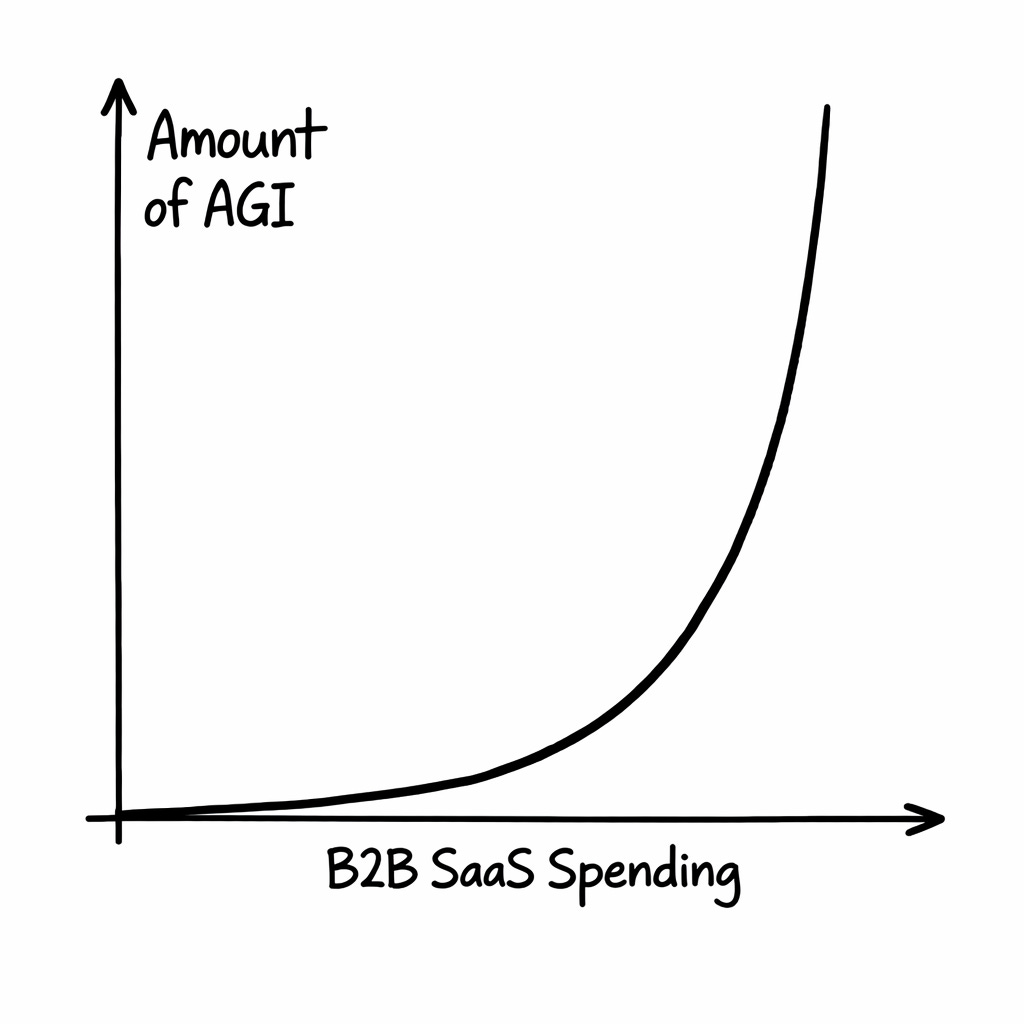
So treat yourselves to some B2B SaaS this year. Do it for civilization! And while you’re at it, come to Network School too.
A low bar, though you might not know it yet.
I put nonzero effort to write a good line that brights out the strength of the “it’s not X — it’s Y pattern” that has unfortunately become infamous for other use cases
Probably also literally
I wonder if New Zealand might have some appeal for a NS campus? What it offers:
- Immigration is straightforward
- time zone is just 4 hours from PST and 4 hours from Beijing Time
- after maybe Singapore and HK, probably the best balance of tight integration with both the US and China you'll find anywhere
- beautiful natural environment
- Routinely tops WB Ease of Doing Business rankings with easy one-day business registration, streamlined and predictable regulatory environment, and a transparent legal system
- links to space with regular Rocket Lab satellite launches
NZ has always looked for ways build get past the tyranny of distance. Critical mass of driven entrepreneurial culture can be a problem there (the country is so _chill_) and I wonder if a NS campus could be a solution.
It’s good to read you again.