

Paul Ehrlich, the world’s most influential antinatalist, died last week. Ehrlich’s ideas were terrible for the world, and only grew in popularity the more damage they did.
Still, his career is a fount of fascinating questions. Why is China hyper-susceptible to some (bad) Western ideas, like Ehrlich’s one child policy? What does it even mean for an idea to be “good in theory, but bad in practice”? And why have pro-natalists failed to overturn the Ehrlich revolution?
Science progresses funeral by funeral. It seems politics will have to go the same way.
I now work full time Network School, which you can read about here, or apply to visit here. Also feel free to message me here or email me at [firstname]@ns.com if you have any questions. If you’re in the area, also drop by for our first OpenClaw Meetup, which I will be speaking at.
China Westernized a Lot
“China became rich but did not become free” is an American cliche. Of course, to Americans “China did not become free” means “China didn’t adopt American beliefs”. But is that even true?
Let’s steelman their argument. The Chinese Communist Party still has “Communist” in its name. They wave the hammer and sickle flag. The Chinese state does terrible things to founders, like imprisoning Alibaba founder Jack Ma. It heavily censors social media and bans American companies.
Look a bit closer and you’ll see the wall against American influence is not so airtight. Plenty of western culture has seeped through and influenced the heart of Chinese political culture. China is feminist, antinatalist, gerontocratic, and environmentalist. Environmental slogans are plastered in virtually all government buildings in Chinese cities. Famously, the one-child policy was directly caused by Paul Ehrlich’s visit to China, while communism itself was an export from German and French intellectuals through the Soviet Union.
It’s not all bad. China dealt with climate ideology in a much healthier way than Europe. They build better electric cars and solar panels than the US. China has American shopping malls. It has same-day delivery. Everyone who lives in China notices that it has become much more “American”.

So if you’re an American nationalist the question shouldn’t be “why hasn’t China adopted Western cultural norms?” The premise is not true. China has adopted western norms. The question should be “why has China only adopted Democrat norms?”
The question answers itself. America exported the values that the State department cared about exporting. They exported feminism and environmentalism just fine, because the State department cared more about women’s education and climate change than free speech and free markets.
Chinese elites and State department elites are the same: they want to go to Harvard, not intern at the Cato Institute. So China adopted the values of Harvard, not the Cato Institute.
The ways that China resists American values flow in the same direction. China censors social media, locks up founders, and stops its most valuable citizens from leaving. It does everything American leftists dream of, but aren’t capable of. China adopted the values of unfree America, while becoming the enemy of free America.
At the same time, the State department became Chinese. The State department not only neglects freedom of speech, it undermines freedom of speech. It not only neglects free markets, but suppresses free markets.
And that’s before the lockdowns.
The story of the lockdowns is simple. The first time in my lifetime the Chinese Communist Party exercised a real totalitarian seizure of power, Western governments cheered. China finally did the thing they were fearmongering about for decades and Western leaders tried their hardest to copy it. The only thing that saved the Western world is our idiocracy. It really is that simple.
Conservatives love clash of civilization stories. “It’s just like Sparta versus Athens.” Except that’s not just wrong, it’s the opposite of the truth. We had a real shot to export America’s most important cultural values. China was open to us. And the lib international policy establishment exported an uninterrupted sequence of terrible ideas instead. The American government betrayed them by betraying American values. Are Chinese people wrong to distrust us?
Why Pronatalism Will Fail
Pronatalism in American politics is a mathematical impossibility.
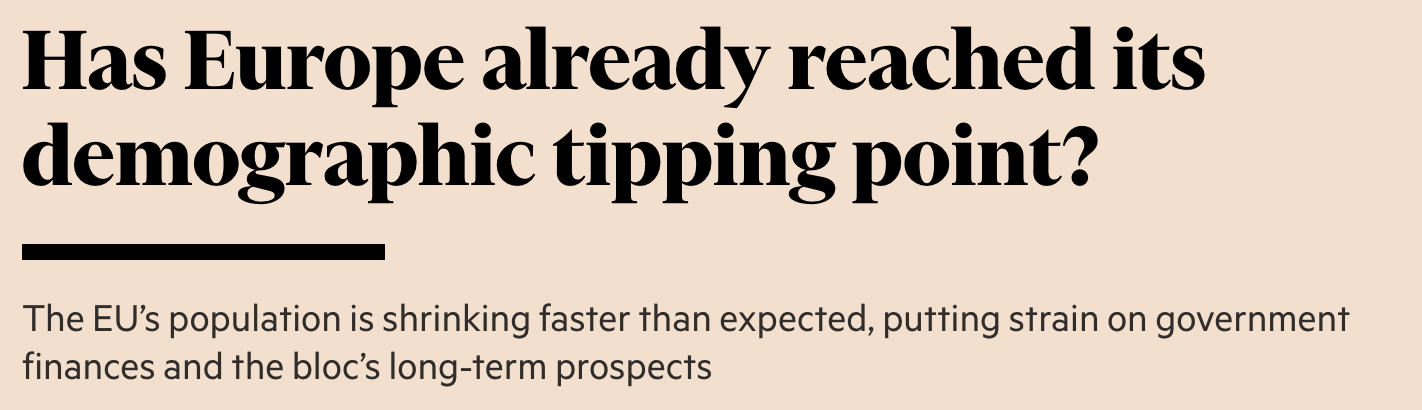
Pronatalists, on both the right and on the left, to the extent they exist, frame it as a means to uphold the economic status quo.
As the readers of my award winning article already know, the economic arrangement of America is continual wealth transfers to boomers. Our national wealth transfer financially elevates the mere existence at the end of life over the beginning of life.
To pretty much all of you, that sounds bad for fertility. But to the mathematically inclined, you might be starting to see why it is literally impossible for economic policy to increase the American birthrate in coming years.
The ratio of working adults to retirees will only get worse.
To sustain the existing level of benefits with a lower ratio, the burden on working adults will have to worsen.
Antinatalist wealth transfers to the old far outweigh any feasible pronatalist policy. In fact, merely the increase in burden on working adults from the shifting ratio of depedents to dependees far outweighs any feasible pronatalist policy.
Therefore the net effect of economic policy on fertility is guaranteed to worsen.
The hunger to consume outweighs the hunger to create. You do not live in a just world.
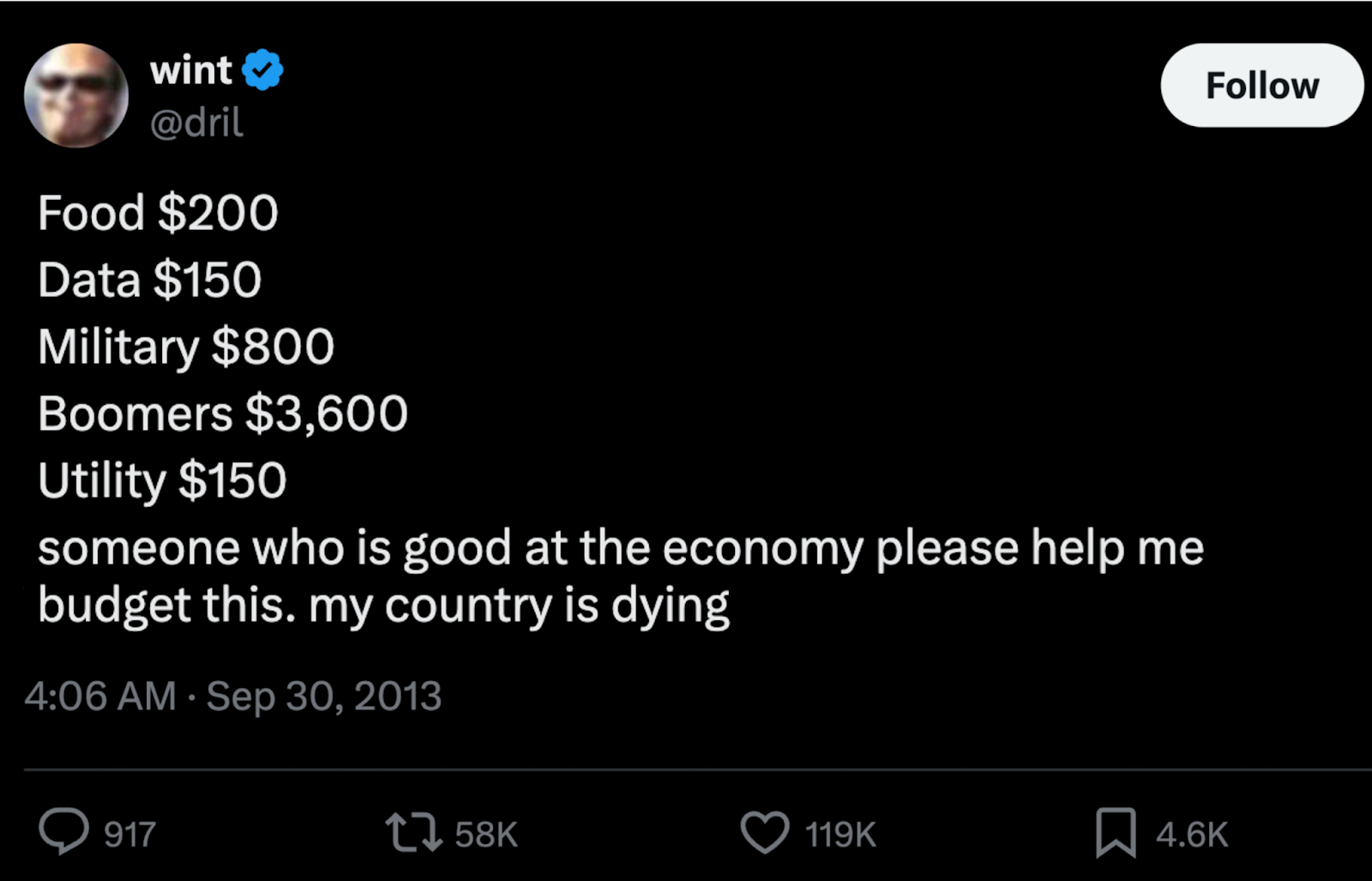
Do I even have to say it? Move to a place with fewer old people and more young people. Skepticism of the financial viability of Network States always surprises me, because it’s literally easier to imagine all the young people in Western countries leaving than it is to imagine repealing social security and its European equivalents. It’s already happening in some EU countries. So move to a Network State. Bring your friends. In the long run, literally nothing else matters for your tax burden. Plus, it’ll be more pleasant.
Ehrlich is Still Winning
Paul Ehrlich’s most famous idea, which he wrote about in The Population Bomb, was that population growth would cause uncontrollable resource scarcity. In 1980, Paul Ehrlich famously put his money behind this idea in a bet against economist Julian Simon. Simon challenged Ehrlich to pick any raw materials and any future date at least a year away. Ehrlich chose five metals—chromium, copper, nickel, tin, and tungsten— and a ten-year deadline. By the end of the decade, the real prices of all five metals had dropped, so Ehrlich begrudgingly mailed Simon a check for $576.07.
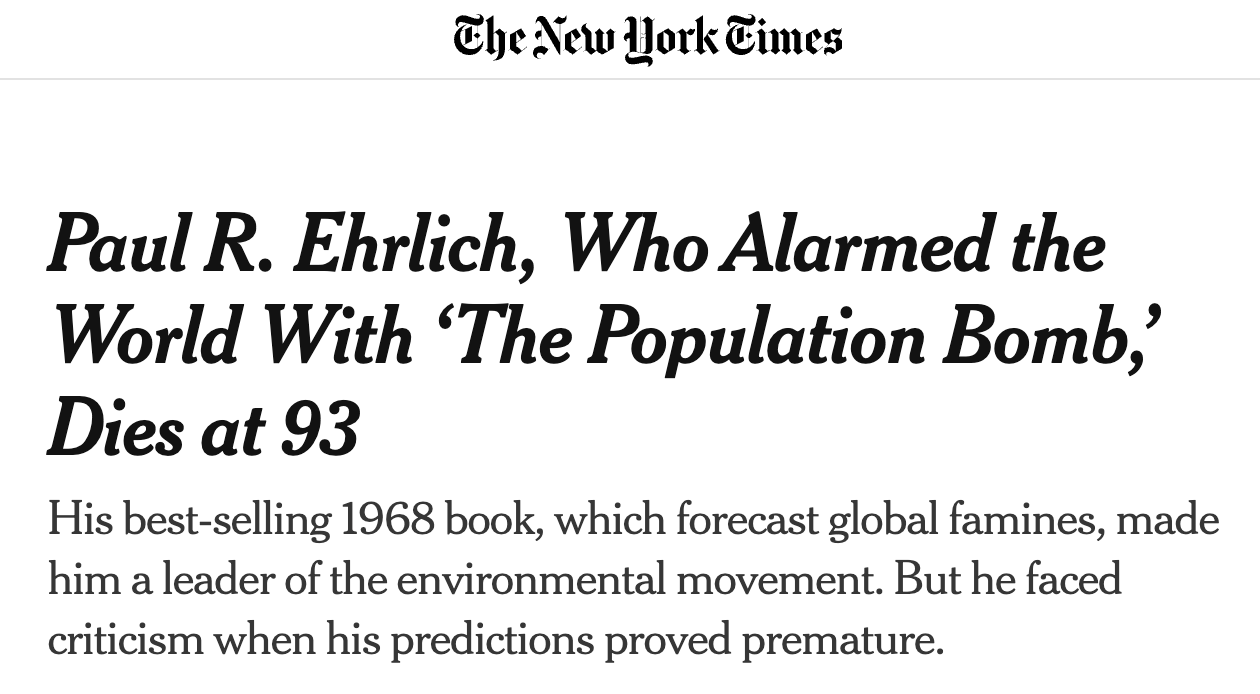
Ehrlich lost the bet, but he won the debate. Ehrlich’s stardom far surpassed Simon. Ehrlich caused the one child policy — one of China’s biggest policy blunders, even by Chinese standards. Hhis degrowth ideology is so entrenched in legacy journalism that the New York Times continues to cover for him. Truth and influence are not the same.
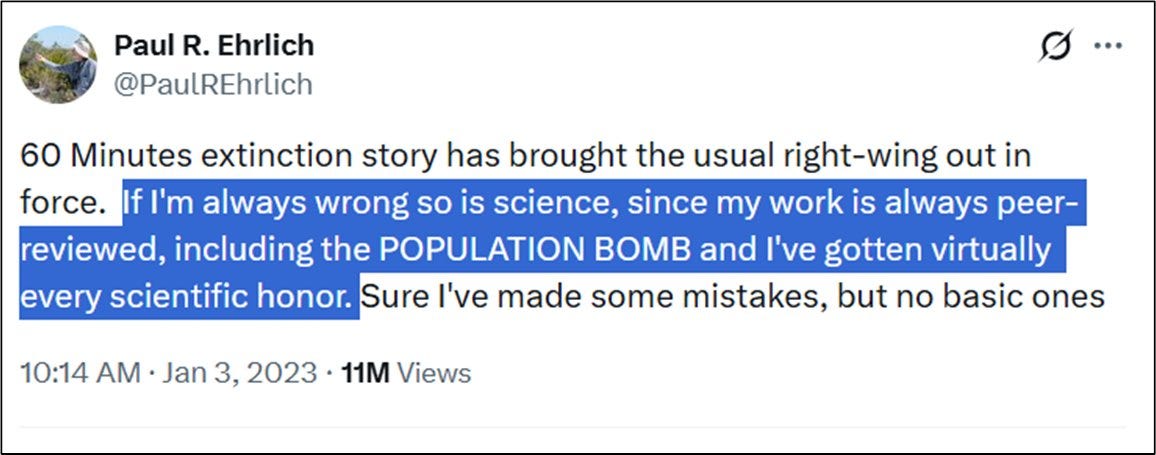
Ehrlich’s intellectual descendants are still doomsaying. There is some psychological fascination with pretending all good things must come with an ultimate price, as if every scientist offered their inventions with the guile of a genie in a bottle. To some susceptible fraction of the population, this argument only becomes more persuasive the more it is devoid of evidence.



Ehrlich himself rose to stardom in a world ravaged by the delusional predictions of Thomas Malthus. Now, the Lich is resurrected in new and somehow even more retarded doomsayers, wielding even more catastrophic policy proposals, finding their spotlight in an equally gullible media landscape. Man never learns.
Why do Degrowthers Win?
That brings us to Ehrlich’s legacy. Why does the Lich keep winning? The border of both the laws that rule us and acceptable discourse is pushed further and further toward catastrophic degrowth rather than abundance.
The short answer is if you’re in the business of destroying people economically, you’re in the business of destroying people politically.
It was odd to see many of my friends turn against Libertarianism during the COVID lockdowns. If there was any time to be a Libertarian, it was then. But after they explained, it made sense. To summarize their criticism, Libertarians were too agreeable. They wanted to have positive sum solutions. They wanted to write policy papers about optimal tax rates. They didn’t want to spark a kinetic rebellion against the most tyrannical American threat in my lifetime.
The void of what Libertarianism should be turned people against what Libertarianism was.
There’s an alternate timeline where Libertarians use all levers of power to defeat their enemies. Bezos should take over the Washington Post and enforce his opinions as much as woke editors did in the 2010s. Libertarian groups should try as hard to put Zohran Mamdani in jail as left left-wing groups did against Donald Trump. Even without passing new laws, Libertarians could greatly reduce socialists’ ability to take power.
So why don’t they?
Negative-sum thinking is adaptive to democracy. The petty resentment of socialists and the bloodlust of warmongers are stronger motivations to destroy your political opposition than wanting to contribute to the world. The government is a blunt tool of destruction. The world’s largest hammer is wielded by hammer lovers.
Even if Libertarians work in public policy, they just want to write about ideas. They don’t want to fight. Their minds live in a just world fallacy where writing the right economics paper matters more than putting socialists on trial. In real life, the good are unwilling to bring justice to the evil, and the evil are willing to harm the good out of mere sadism.
The Optimistic Future
Despite all that, I’m optimistic for the future. God is kinder than man.
Representative democracy is not just a check on anarchy, but a check on suffrage. 500 years was not enough for Thomas Hobbes to be read deeply. The president is a check on suffrage. By being their scapegoat, the president suppresses the damage the electorate is capable of. In this sense, Trump deserves all the gratitude we are capable of.
The hope for democracy is gradual disempowerment — in which no volume of bitter cringers can touch your God-given right to be free.
Brian you’ve convinced me. I’m coming. At least for a month to see. Perhaps I will see u soon
I love your comments on China, namely that they have been open to American ideas, just not the ones we would like. It’s almost comical. Did we export those ideas thinking it was a good thing? And if so, it explains why so many top Dems have recently praised China.